South Lebanon Talks
About
First Talk
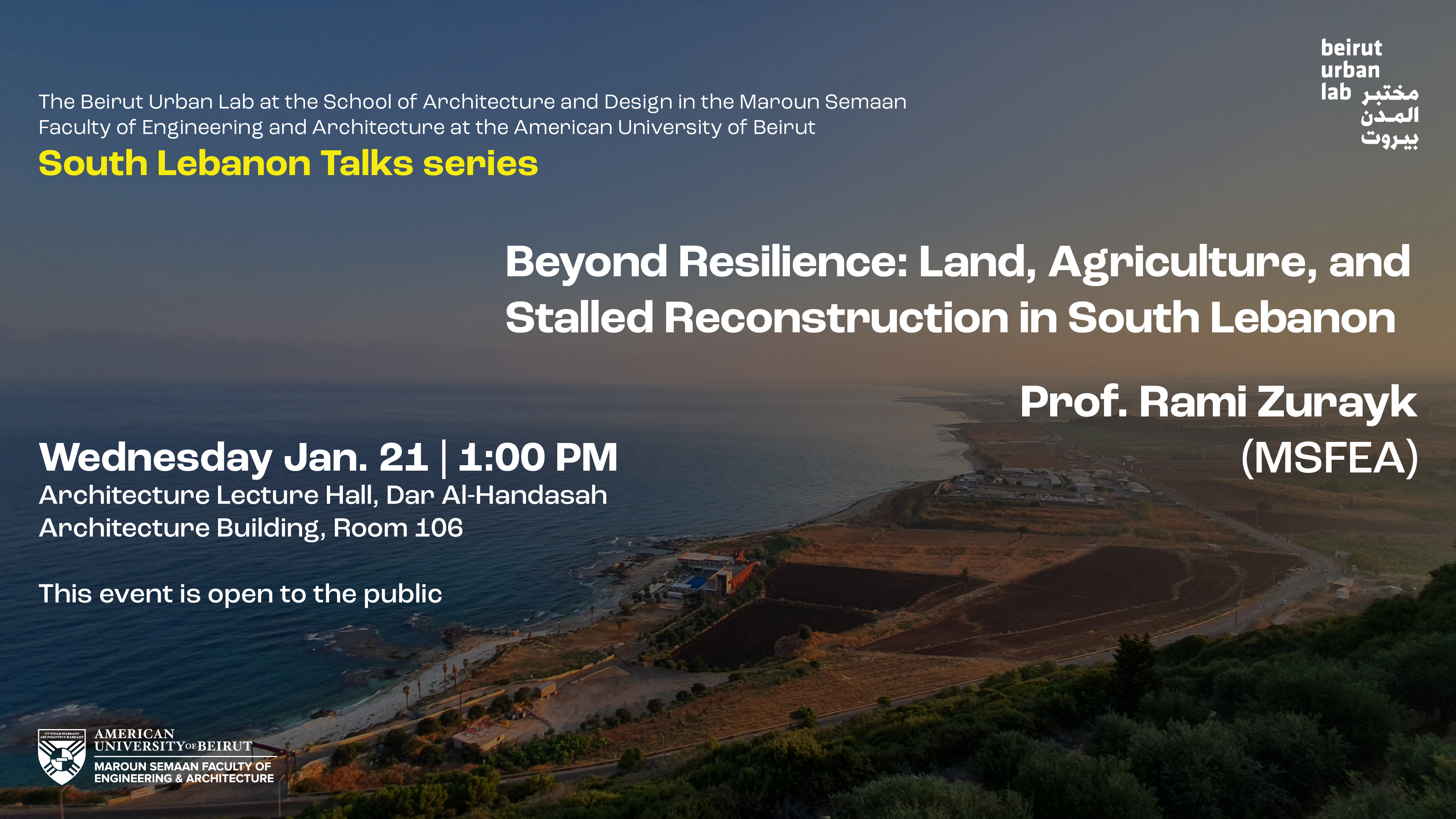
The first talk will be delivered by Prof. Rami Zurayk, titled:
“Beyond Resilience: Land, Agriculture, and Stalled Reconstruction in South Lebanon.”
📅 Wednesday, January 21
🕐 1:00 pm
📍 Architecture Lecture Hall, Dar Al-Handasah Architecture Building, Room 106
Abstract
Post-war recovery in South Lebanon has followed a recurrent trajectory since the 20th century: rapid attention to visible destruction, followed by prolonged neglect of land, agriculture, and environmental remediation. Drawing on long-term research on war-affected lands, agrarian systems, and environmental damage, as well as comparative insights from the post 2006 war, I examine how state led recovery repeatedly fails to treat land-based livelihoods as a condition for durable return.
The analysis is grounded in sustained field presence and continuous communication with communities in the South—particularly farmers—allowing recovery to be examined as a longitudinal process rather than a post hoc assessment. I differentiate three zones shaping recovery trajectories: the immediate border zone, where access and reconstruction are most restricted; the area south of the Litani, where return is constrained by regulatory uncertainty; and the region north of the Litani, where rebuilding proceeds unevenly while cumulative land degradation remains largely unaddressed.
A comparison between 2006 and the present highlights both continuity and escalation. In 2006, explosive remnants—especially cluster munitions—rendered vast areas of agricultural land unusable long after the ceasefire, with contamination still documented as a development constraint. In the current context, reconstruction is not only stalled but return and access to agricultural areas remain restricted in parts of the South, producing displacement through administrative and spatial means as well as physical destruction and mined borderlands. I critically reframe “resilience” through South Lebanon’s history of resistance, arguing that resilience is increasingly mobilized as a governance discourse that normalizes repeated harm and deferred repair.
Second Talk
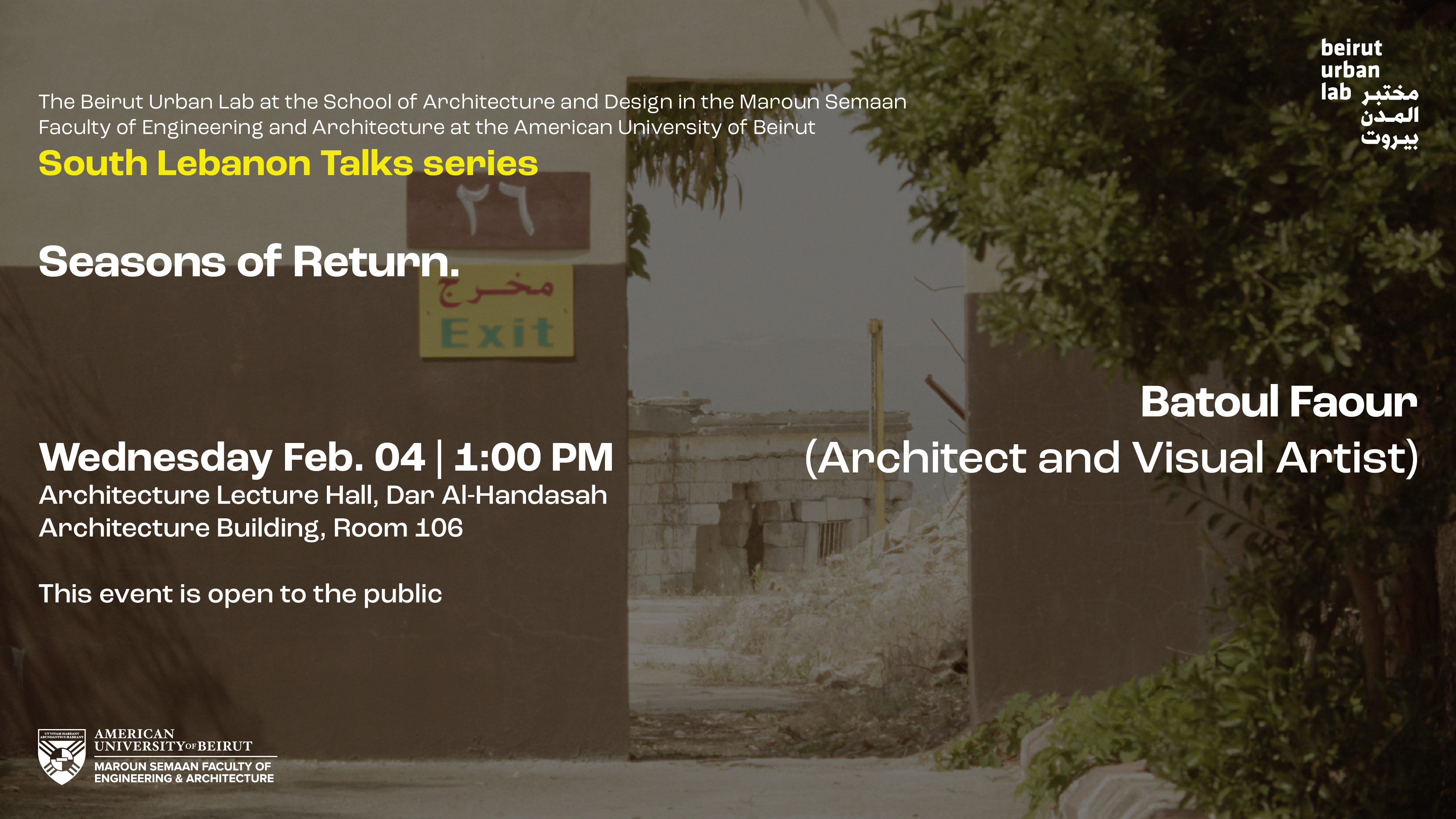
The second talk will be delivered by Batoul Faour, an architect and visual artist, titled
“Seasons of Return.”
📅 Wednesday, February 4
🕐 1:00 pm
📍 Architecture Lecture Hall, Dar Al-Handasah Architecture Building, Room 106
Abstract
Seasons of Return reflects on repeated journeys back to the Southern town of Khiam in the aftermath of the recent and ongoing systemic Israeli aggression. Return here is seen not just merely as a moment of arrival, but an ongoing negotiation with and against destruction, occupation, and uncertainty. Situating recent Israeli incursions within a longer history of imperial intervention, the village is read as a site where successive empires have inscribed power onto land, infrastructure, and everyday life. These layered histories remain embedded in the ground itself, resurfacing through new cycles of violence. Through and despite these conditions, seasonal rhythms of the land and communal acts of repair continue to shape Khiam’s social fabric, revealing how life is reassembled in landscapes marked by recurrent disruption.
Third Talk
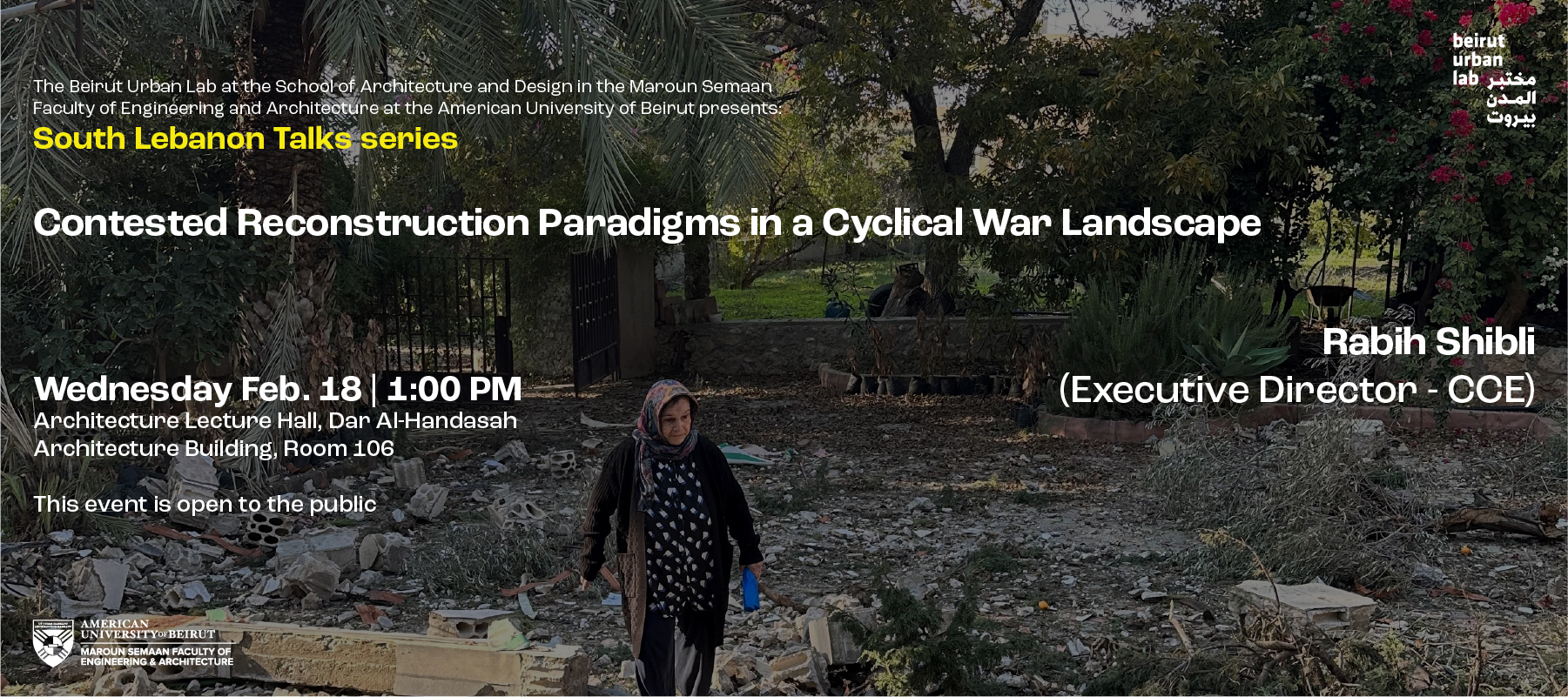
The third talk will be delivered by Rabih Shibli, titled:
“Contested Reconstruction Paradigms in a Cyclical War Landscape”
📅 Wednesday, Feb 18
🕐 1:00 pm
📍 Architecture Lecture Hall, Dar Al-Handasah Architecture Building, Room 106
Abstract
Postwar reconstruction became an internationalized practice after World War II with the U.S. led Marshall Plan, conceived as a strategic instrument to contain communism through economic revival of Western European economies. This model was later institutionalized by the World Bank and IMF, which promoted a capitalist prescription for peacebuilding throughout the Cold War phase. After 1989, global conflicts shifted toward internal civil wars, prompting the international community to adopt disarmament, demobilization, and reintegration (DDR) programs and UN-led trusteeships. Following 9/11, reconstruction was further securitized under the “War on Terror,” with major powers establishing reconstruction institutions to stabilize war zones.
The evolution of international reconstruction paradigms is reflected in Lebanon’s postwar reconstruction projects: beginning with the 1958 U.S. intervention under the Eisenhower Doctrine and its containment strategy and leading to DDR programs and neoliberal reforms that accompanied privatized reconstruction initiatives such as Solidere post-civil war; the evolution of Hezbollah’s Jihad al-Binaa reconstruction apparatus in the aftermath of the Israeli wars of 1993, 1996, and 2006; the security & surveillance driven reconstruction of the Nahr al-Bared Palestinian refugee camp in 2007; and, most recently, the internationally led Relief, Reconstruction, and Recovery Framework following the 2020 Beirut Port Blast. Each of the four post-conflict reconstruction projects (real estate, jihad for reconstruction, security and surveillance, and the international trusteeship) has its distinct sponsor, mandate, and specific area of operations. Currently, the four projects are unfolding in the same locations that were severely damaged during the latest 66-day war with Israel as follows:
⁃ The real estate: promoting Solidere-like special economic zone
⁃ Jihad for Reconstruction: mobilizing recovery and shelter, consolidating socio-political control
⁃ Security and Surveillance: foreclosing reconstruction by establishing a buffer zone
⁃ International trusteeship: conditioning funding through selective criteria for reconstruction
Fourth Talk
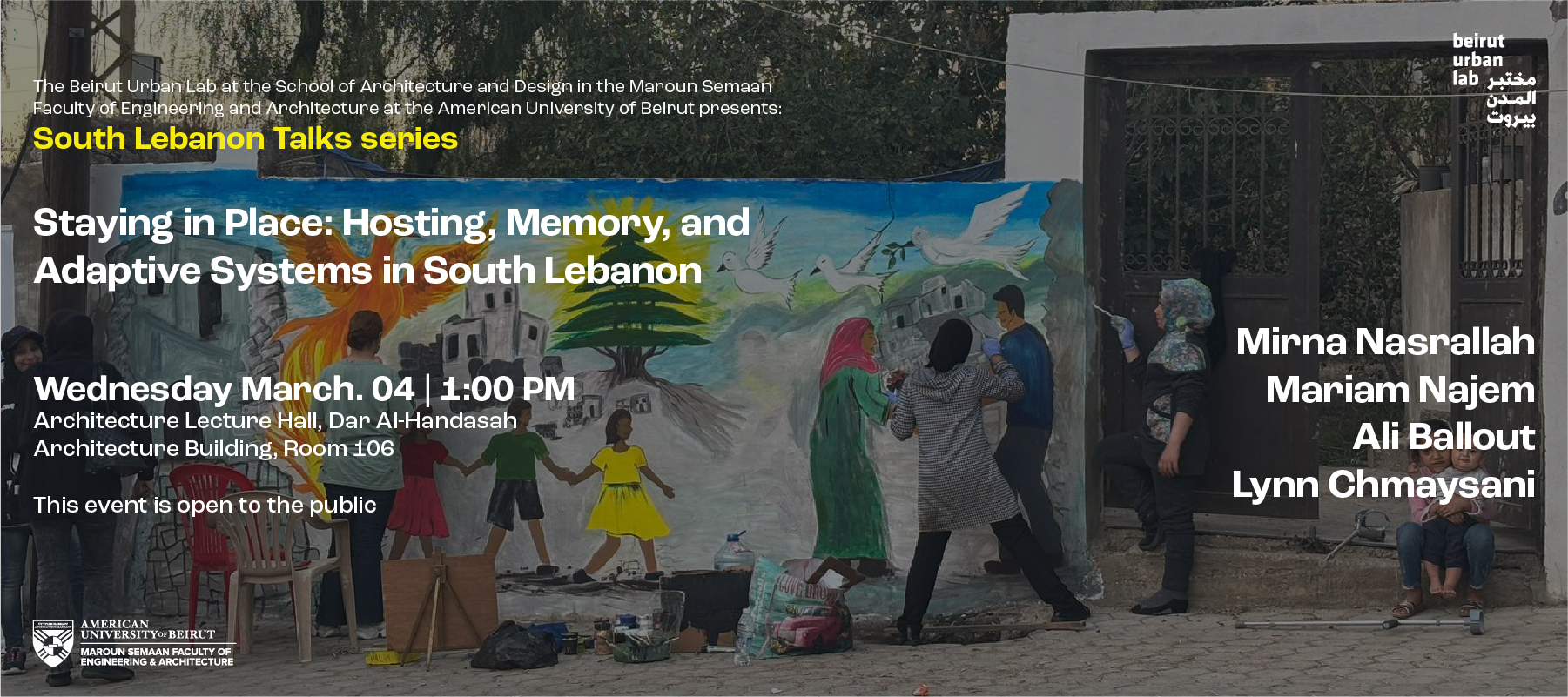
The fourth talk will be delivered by Mirna Nasrallah, Mariam Najem, Ali Ballout, Lynn Chmaysani, titled:
“Staying in Place: Hosting, Memory, and Adaptive Systems in South Lebanon”
📅 Wednesday, March 04
🕐 1:00 pm
📍 Architecture Lecture Hall, Dar Al-Handasah Architecture Building, Room 106
Abstract
South Lebanon is often framed through the language of reconstruction. Yet for many of its villages, war is not a concluded event but an ongoing condition shaped by intermittent escalation, militarized borders, infrastructural fragility, displacement, and fragmented governance. In this context, the question is not simply how to rebuild what was destroyed, but how collective life is reorganized spatially when violence persists.
This panel brings together four thesis projects situated in Aaynata, Meis El Jabal, Taybeh, and Jbaa. Across different territories and spatial scales, the projects share a central concern: how can architecture imagine the possibility of staying in place under continuous bombardment?
Rather than approaching staying as passive endurance, the projects examine the spatial systems that make it viable. In Taybeh, hosting is reinterpreted as a socio-spatial framework through which return, place identity, and collective memory are sustained across cycles of displacement. In Jbaa, dispersed infrastructures and collective shelters translate everyday resistance into adaptive strategies that respond to fluctuating intensities of risk. In Meis El Jabal, architecture is explored as a territorial system negotiating exposure, proximity, and survival within a militarized border landscape. In Aaynata, the re-imagining of collective ground is framed as a political intervention that counters erasure and reasserts memory within space structured by recurrent violence.
Together, the projects move beyond reconstruction as replacement. They investigate architecture as adaptive infrastructure, as governance in the absence of governance, and as a spatial mechanism through which communities negotiate uncertainty. In doing so, they reimagine different futures and alternative ways of living in South Lebanon, not as idealized projections, but as situated possibilities emerging from local practices of hosting, memory-making, adaptation, and collective organization.
Staying in place becomes a practice of reclamation: reclaiming space structured by violence, reclaiming memory from political narrowing, and reclaiming the capacity to define how inhabitation unfolds.